 Bright Ideas
Technology
Lighting, home and building automation, protocols and artificial intelligence, explained without jargon.
Home automation
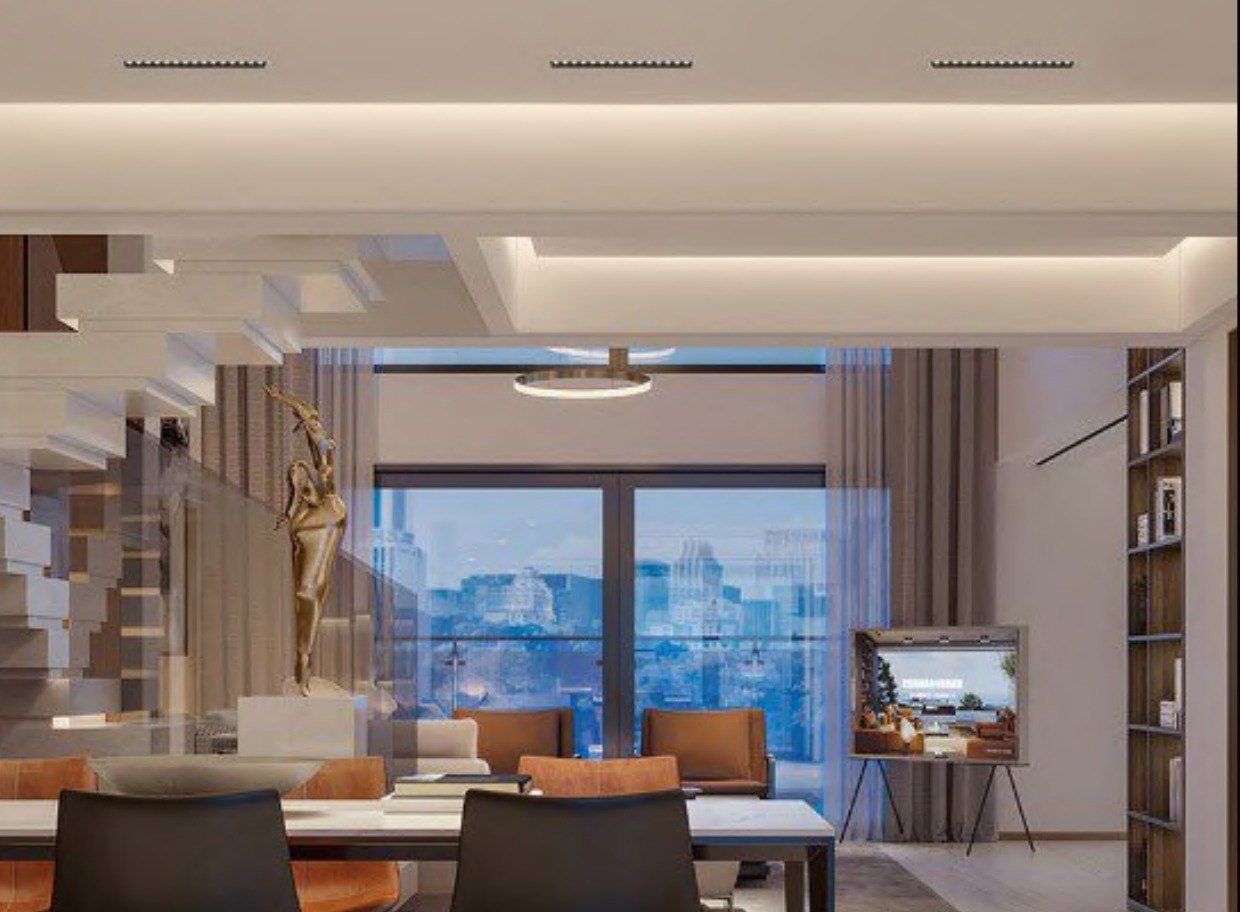
Home automation connects the lighting, blinds, climate, security and appliances in a home so they work together and respond to what you need, without going switch by switch.
It is controlled from wall panels, your phone or your voice. With scenes, a single touch changes the whole house: the lights dim for dinner, the curtains close for a film, or everything switches off when you leave.
It also saves energy. Lights switch off in empty rooms, climate doesn’t run in rooms nobody is in, blinds let the sun in or keep it out depending on the season, and consumption is visible on your phone so you know where it goes.
Building automation
Building automation takes the same idea to a whole building: offices, hotels, large stores or warehouses. It integrates lighting, climate, blinds, access, security and energy metering, and manages everything from a single point.
Here what matters most is savings and control. In a building, much of the cost goes on empty spaces and idle hours. Building automation switches on light only where there are people, adjusts it to daylight, runs climate by zones and schedules, and alerts maintenance when something fails.
The difference, in short
The technology is similar. What changes is the scale, the goal and who uses it.
Home automation is designed for a family living in their home who want comfort, security and atmosphere, with some savings. Building automation is designed for buildings where many people who are not the owners work or stay, and it is run by a technical manager whose priority is to spend less and keep everything under control.
Lighting technology
What you don’t see on day one, but notice for years.
The quality of a lighting installation isn’t measured the day it is switched on, but five or ten years later. It depends on the LED, how heat is dissipated, the power supply and how it was installed. That is why we choose every component for how long it will last and how it will look.
Our track record includes building entrances with lamps installed in 2013 that still haven’t had a single failure. That is the standard we aim for.
COB strips place the LEDs so close together that the line of light looks continuous, without dots, even without a diffuser. It is the basis of our strips.
The colour rendering index tells you how close colours look to reality. With high CRI, products, wood or skin look natural. We use CRI > 90, and > 95 in the PRO range.
Colour has quality levels too: a good red and a cheap one are night and day. We work with RGB, RGBW and colour + white (RGBCCT) with pure primaries.
From warm white (2,700 K) to cool (6,500 K) in the same fitting, to follow each time of day or each moment of an event.
Spotlights and downlights with UGR < 9: they light without straining the eyes, even when you look straight at them.
Each voltage for its use: 24 V for precision strips, 48 V for magnetic track and 230 V for long runs without intermediate power supplies.
In digital strips every segment has its own colour and moves independently, controlled by SPI or DMX. See pixel controllers
The profile protects the strip, dissipates heat, which is what shortens LED life most, and leaves a clean finish. We have around 170, for every type of mounting.
Control protocols
We are not tied to any one: we choose the one each project needs.
A low-power wireless mesh network: every device strengthens the signal for the next. It is the basis of our home automation and the best option for renovations without building work, in existing homes, hotels and offices.
The common standard that lets devices from different brands work together and with the main voice assistants. Our panels are compatible.
A Bluetooth mesh network to control large groups of fittings without control wiring, commissioned from a phone.
For devices that move more data: cameras, video doorphones and screens.
Direct remotes and receivers, with no gateway or network. We have used it since 2008 and it is still the simplest solution when a space only needs independent control.
The lighting control standard for buildings. Each fitting has its own address: it can be dimmed, grouped and reports faults. Standard in offices and hotels.
The open building automation standard, with a wired bus. For new builds and large buildings where the engineering calls for it: we integrate lighting and control with the KNX installation.
DMX is the language of show lighting: moving heads, lasers, pixel and console. Art-Net carries DMX over a network for large shows.
How we choose
First, whether it is a new build or a renovation. In a new build we can run cables, and in large buildings DALI or KNX give a robust, easy-to-maintain installation. In a renovation, wireless (Zigbee, Bluetooth Mesh) avoids opening walls and ceilings.
Then, who will use it and who will maintain it. A family wants simplicity and an app; a hotel or office needs maintenance to see everything from one panel. And if there is a show, DMX.
Often the best answer is to combine: DALI for a building’s lighting, Zigbee for the rooms and Matter so everything talks to the voice assistant.
Proactive artificial intelligence
It doesn’t wait for an order: it gets there first.
The more you use it, the better it knows your routines, and it suggests the right scene for each person, time and room.
No commands to learn. Just say "it’s getting dark" and the right lights come on.
The panel wakes up as you approach and shows what you need at that moment.
It monitors consumption across the whole home or building and switches off what nobody is using.
It works the same in a home as in a building: at home you notice it in comfort; in a hotel or office, above all in the bill.
And it is compatible with Matter, the standard that lets devices from different brands work together.
Regulations
Building automation is no longer just an upgrade: in many cases it is mandatory.
We help you find out where your building stands and what it needs to comply.
Frequently asked questions
Can home automation be installed without building work?
Yes. With wireless technology such as Zigbee or Bluetooth Mesh, switches are replaced by smart panels and modules and sensors are added without opening walls. In most existing homes, hotels and offices it is the best option.
What is the difference between home and building automation?
Home automation automates a home for comfort, security and savings. Building automation automates a whole building, such as an office, hotel or warehouse, and focuses above all on saving energy and managing everything from one place.
Does home automation save energy?
Yes. It switches off lights in empty rooms, avoids heating or cooling rooms nobody is in, uses blinds to let the sun in or keep it out, and shows consumption so you know where it goes.
What is CRI and why does it matter?
CRI, the colour rendering index, measures how faithfully a light shows colours. With CRI > 90 colours look natural. In shops, stands, restaurants and hotels it is what makes products, food or materials look as they are.
Which is better: Zigbee, DALI or KNX?
It depends on the project. Zigbee is ideal for renovations without building work. DALI is the standard for controlling a building’s lighting. KNX is common in new builds and large buildings. They are often combined.
Does it work with Alexa, Google or Apple?
Yes. Through Matter, our panels integrate with the main voice assistants, and some models have Alexa built in.
What is proactive artificial intelligence?
A system that learns how you use your home or building and gets there first: it suggests the right scene for each person, time and room, understands you when you speak normally and switches off what nobody is using.